

Why Does Modern BJJ Culture Feel So Cringey?

Updated: Oct 15
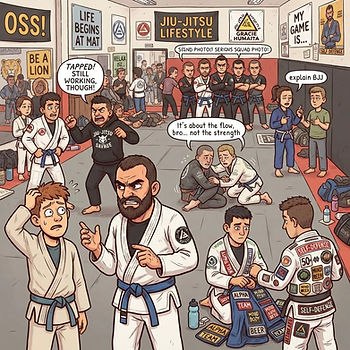
I've been doing martial arts for a long time, and one thing I've noticed about Brazilian Jiu-Jitsu is that the culture surrounding it has become almost as interesting as the art itself. Sometimes that's a good thing. BJJ has developed an incredible community, and there are a lot of genuinely good people involved in it. But every once in a while I look at something happening in modern BJJ culture and have the same reaction: "Jesus Christ, that's cringey."
I don't mean that BJJ itself is cringey. I love BJJ. I teach it. I train it. I've spent a huge part of my life on the mat. What I'm talking about is the strange tendency for some people to turn the practice of grappling into an elaborate performance of what they think being a martial artist is supposed to look like.
There is a difference between doing jiu-jitsu and performing the identity of someone who does jiu-jitsu. I think modern BJJ has gotten increasingly good at the second one.
The Martial Art Became an Identity
There has always been some identity attached to martial arts. That's nothing new. You put on a uniform, join an academy, get promoted through a ranking system and become part of a group. Those things can be useful. They create belonging, establish standards and give people something to work toward.
But social media has taken that natural sense of identity and turned it into something much bigger.
Today you can build an entire personal identity around BJJ without actually needing to spend much time practicing it. You can buy the rash guards, collect the patches, wear the shirts, follow the personalities, listen to the podcasts, argue about gi versus no-gi, debate competition rules, watch instructionals and make memes about white belts. You can participate in BJJ culture all day without actually getting on the mat.
That's a strange development for a martial art whose greatest virtue has always been its ability to cut through bullshit.
You can tell me that you're tough. You can tell me that your system is effective. You can tell me that your technique is the secret to controlling everyone from mount. You can tell me about your lineage, your philosophy and your understanding of combat.
Then we can train.
That's always been one of the beautiful things about grappling. Eventually, somebody grabs you and reality answers the question.
But social media allows us to spend an enormous amount of time talking about the practice without actually engaging in the practice. The performance becomes visible to thousands of people, while the actual training remains private.
And the internet rewards performance.
We Like the Idea of Being a Martial Artist
I think some of this comes from something very human. People don't just want to learn BJJ. They want BJJ to say something about who they are.
They want to be tough.
They want to be disciplined.
They want to be dangerous.
They want to be resilient.
They want to be part of something.
They want to feel like they've chosen a harder path than everyone sitting on the couch.
None of those desires are inherently bad. In fact, they're part of what makes martial arts attractive in the first place. The problem comes when the image becomes more important than the behavior.
You see this in the endless language about warriors, killers, savages, wolves, lions, embracing the suck, overcoming adversity and becoming the best version of yourself. Some of it is harmless fun. Some of it is genuinely useful. But after a while it becomes difficult to tell whether we're training to become better martial artists or trying to convince everybody else that we're the kind of person who trains to become a better martial artist.
The funny part is that the people who actually train hard usually don't need to advertise it very much. They just train. The guy who has spent years getting thrown, smashed, submitted, injured, humbled and occasionally successful generally doesn't need to convince you that he's tough. He has already had plenty of opportunities to find out for himself.
The behavior is the evidence.
The Self-Helpification of BJJ
Another thing that makes modern BJJ culture feel strange to me is how often we turn ordinary training experiences into profound life lessons.
You got swept? - That's a lesson about resilience.
You got submitted? - That's an opportunity for growth.
You got promoted? - It's not about the belt. It's about the journey.
You showed up tired? - Discipline beats motivation.
You lost a competition? - You learned more from losing than you ever could from winning.
And look, there is truth in all of those statements. Training can absolutely teach us things about ourselves. I've learned a tremendous amount about patience, preparation, frustration, fear and failure through martial arts.
But sometimes I think we take this too far.
Sometimes getting swept just means you got swept.
Sometimes the lesson is not that the universe has presented you with an opportunity for personal growth.
Sometimes the lesson is that you left your leg in a stupid position and somebody passed your guard.
One of the things I've always pushed back against in martial arts is the idea that practicing a martial art automatically makes you a better person. It doesn't. Martial arts can give you opportunities to develop discipline, humility, courage and self-control, but the training doesn't magically install those qualities in you. You still have to choose them.
A black belt doesn't make you wise. Getting choked doesn't make you humble. Competing doesn't make you courageous. Showing up to class doesn't make you disciplined in every other area of your life.
You have to actually become those things.
The Guru Never Really Went Away
This is where I think BJJ has an interesting contradiction.
One of the things that made Brazilian Jiu-Jitsu different from many traditional martial arts was the emphasis on live training. You didn't have to simply believe that your instructor's technique worked. You could try it against somebody who was actively resisting.
That was enormously healthy. It created a mechanism for testing claims.
But somehow we managed to recreate the martial arts guru anyway.
The modern guru may not stand at the front of a dojo wearing a traditional uniform and talking about ancient secrets. He might have a million followers on Instagram, a successful competition record, a YouTube channel, a podcast, an instructional library and a very strong opinion about everything. The structure is different, but the psychological relationship can be remarkably similar.
This person has figured it out. Follow him. That's where I think we have to be careful.
A great BJJ practitioner may know an enormous amount about BJJ. A great coach may know an enormous amount about coaching. That doesn't mean either one suddenly possesses special knowledge about nutrition, parenting, business, politics, relationships or the meaning of life.
I've always liked the idea that I'm a coach, not a guru. I'll teach you what I know. I'll tell you what I think. I'll explain why I think it. Then I'd like you to test it.
You don't owe me your intellectual obedience because I have a black belt. And you shouldn't.
Loyalty Is Not the Same Thing as Obedience
Academy culture can be another source of this problem.
I actually think loyalty is a good thing. I want people to care about their academy. I want training partners to look out for each other. I want people to feel like they belong to something. A good gym should feel like a community. But there is a point where loyalty gets confused with obedience.
Your coach isn't infallible.
Your academy isn't infallible.
Your lineage isn't infallible.
And leaving a gym doesn't mean you betrayed anyone.
I've seen martial arts cultures where questioning the coach is treated almost like questioning the family. That's where healthy culture starts turning into something else. The instructor's preferences become doctrine, and eventually students aren't simply learning jiu-jitsu. They're learning what their particular tribe believes about jiu-jitsu.
That's dangerous because one of the great advantages of combat sports is that reality doesn't care about your affiliation. A technique either works or it doesn't.
Maybe We Should Take the Practice More Seriously and Ourselves Less Seriously
This is probably the part that bothers me most about modern martial arts culture.
We have an activity that is inherently humbling. You spend years learning how to control another human being while simultaneously discovering all the ways another human being can control you.
You get tired.
You get frustrated.
You get tapped by people you thought you should beat.
You get beaten by smaller people.
You occasionally do something really well and then spend the next five rounds getting your ass kicked.
It's a wonderful environment for developing some perspective. And yet we sometimes surround that experience with an enormous amount of ego, branding, mythology and self-importance. I think we'd be better off if we took the training more seriously and took the identity a little less seriously.
You don't have to call yourself a warrior.
You don't have to turn every failure into a motivational speech.
You don't need to pretend your black belt has given you some special insight into the human condition.
Learn the technique.
Try it against resistance.
Figure out why it didn't work.
Come back next week and try again.
That's actually pretty damn profound on its own. Maybe that's why the cringey stuff bothers me. Not because I think martial arts should be stripped of personality, culture or community. Quite the opposite. I think those things are important. But the culture should serve the practice, not replace it.
The best martial arts culture I've ever been around doesn't create followers. It creates better martial artists. It gives people good coaches, good training partners, high standards and an environment where they can test themselves honestly. It doesn't require them to believe that their instructor is a guru or that their academy is the only place where the truth exists.
At the end of the day, you don't have to perform being a martial artist.
Just be one.
And if you're actually doing the work, people will figure it out eventually.


Comments