

Should Beginners Stop Learning Combinations?


A blog reader recently sent me a question about one of my recent articles that I thought was worth answering publicly because I suspect other people have had the same thought.
The question was basically this:
"Coach, you say we need to master the fundamentals, but you also say we should stop memorizing combinations. I'm pretty new to this stuff. What the heck am I supposed to do?"
That's a fair question. If you're brand new to MMA or striking, it can sound like I'm telling you two completely different things. On one hand, I'm saying that fundamentals are incredibly important and that you should spend a lot of time developing them. On the other hand, I'm saying that simply memorizing combinations isn't the way to become a good fighter.
So where does that leave a beginner?
The answer is that you should absolutely learn combinations. I don't want a beginner standing in front of a heavy bag trying to philosophically discover striking on their own. You need instruction. You need techniques. You need combinations. You need repetition. If your coach teaches you a jab-cross, you should learn the jab-cross. If they teach you a jab-cross-hook, you should learn that too. There is nothing wrong with practicing combinations, and for a beginner they are an extremely useful way to start learning how strikes work together.
The problem isn't combinations. The problem is thinking that memorizing combinations is the same thing as learning how to fight.
When you're new, a combination gives you a framework for practice. It allows you to concentrate on the mechanics of the individual techniques while also learning how those techniques connect. You can work on your stance, balance, footwork, weight transfer, hand position, recovery and defense while throwing the combination. You can begin to understand why one strike sets up another. That's all good training. But eventually you have to move beyond remembering the sequence.
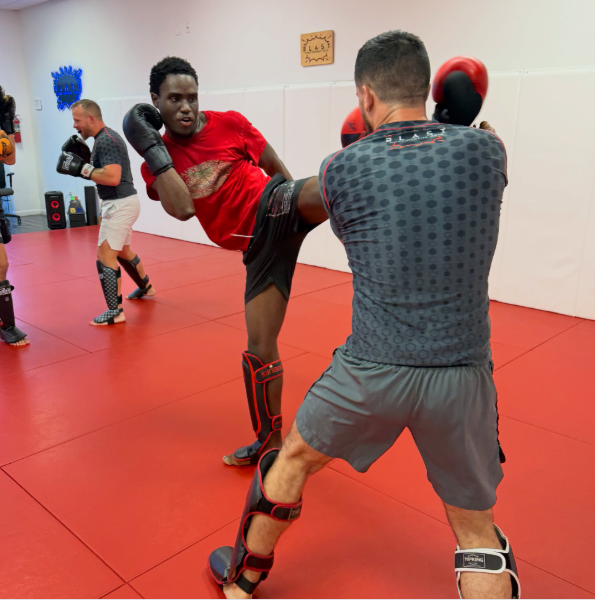
Imagine that you've learned a combination of jab, cross, hook and low kick. You can perform it perfectly on the pads because your coach calls out the sequence and your partner gives you the expected reaction. That's useful. You've developed some technical proficiency.
Now put someone in front of you who doesn't cooperate. He might back away from the jab. He might parry it. He might counter the cross. He might stay in place and cover the hook. He might shoot a takedown after the cross. Suddenly, knowing the combination isn't enough. The problem has changed, and now you have to make a decision.
That's where the fundamentals become important. The fundamental skill isn't really "knowing jab-cross-hook-low kick." The fundamentals are understanding your stance, distance, balance, mechanics, defense, timing and the purpose of the individual techniques. You need to understand what the jab is doing, what reaction you're trying to create, what the cross is supposed to accomplish, and what opportunities might appear when your opponent reacts.
The combination is one example of how those skills can be connected. It isn't a script that the opponent is obligated to follow.
This is an important distinction for beginners because I don't want someone to hear "stop memorizing combinations" and conclude that combinations aren't useful. They are. In fact, memorizing some combinations is part of learning. Early in your development, you have to put some things into your memory so you aren't consciously thinking about every little detail while you're trying to move.
But there is a difference between learning something until you can perform it automatically and believing that the ability to reproduce it on command is the end goal.
The first is skill development. The second is choreography.
This is also why I don't think there is anything wrong with drilling a technique hundreds or even thousands of times. Repetition is how movements become more automatic. The problem is what happens after the movement becomes automatic. If we simply keep repeating the same cooperative drill forever, we can become very good at doing exactly what we have practiced without necessarily becoming better at recognizing when that skill should be used.
Eventually, the training has to become more representative of the problem we're trying to solve.
Maybe the first step is simply learning the jab. Then we learn the cross. Then we learn the hook. Then we put them together. Then we introduce movement. Then defense. Then different reactions from the partner. Eventually, instead of being told exactly which combination to throw, you're given a problem to solve.
If the opponent backs away, what do you do? If he parries the jab, what do you do? If he covers, what do you do? If he shoots after your punches, how does that change your decision? Now you're no longer simply trying to remember a combination. You're learning to use your techniques.
That's a very different skill.
And this is one of the reasons I think beginners sometimes get confused about what "fundamentals" actually means. Fundamentals don't mean doing the same three techniques forever. They mean becoming extremely good at the things that everything else depends upon. Good stance and movement. Good balance. Good defensive habits. Good mechanics. Understanding distance. Understanding timing. Understanding how opponents react. Understanding what your techniques are trying to accomplish. Those things remain important even as the techniques and situations become more complicated.
A good beginner program should therefore give you enough structure that you know what you're supposed to be learning, while also gradually teaching you how to make decisions with those skills. I don't think those are competing ideas. In fact, they're two parts of the same developmental process.
This is a big part of why we built the BLAST development model the way we did. We don't want beginners thrown into completely unstructured training and expected to figure everything out through trial and error. At the same time, we don't want someone to spend years simply collecting combinations and reproducing them on command.
There has to be a progression.
First you have to learn the skill. Then you have to apply it. Then you have to integrate it with the rest of your game. The athlete gradually moves from knowing what to do, to being able to do it against resistance, to recognizing when and why to do it.
That's why you'll see both structured technique instruction and progressively more decision-making in a good development program. The structure gives you the foundation. The resistance forces you to actually use it. The variability teaches you to recognize the problem. And eventually, the goal is for you to stop waiting for someone to tell you what combination comes next.
So if you're new to MMA or striking, here's what I'd tell you: learn the combinations your coach gives you. Practice them. Take the details seriously. Don't rush past the fundamentals because you want to do something more advanced.
But at the same time, don't worry about memorizing an endless library of combinations as though that's what will eventually make you a fighter.
Learn the techniques. Learn how they connect. Understand what they're trying to accomplish. Pay attention to your partner's reactions. And as you develop, start asking yourself what you should do when the situation changes.
That's the progression.
You start by learning what to do. Then you learn how to do it well.
Then you learn when to do it. Eventually, you learn what to do when the other person doesn't let you do what you planned.
That's when you're really starting to learn MMA


Comments