

Your Heavy Bag Can't Fight Back


One of the things I think we sometimes lose sight of in MMA training is that the person standing across from you is the most important part of the equation.
We spend a lot of time hitting bags, working pads, drilling combinations and practicing techniques. All of those things have value. I've used all of them for a very long time and I wouldn't want to coach without them.
A heavy bag doesn't move away when you jab it. It doesn't parry your cross. It doesn't change levels when you throw a combination. It doesn't decide that it would rather counter than retreat. It doesn't suddenly close distance and turn your striking exchange into a wrestling exchange.
But your opponent does. And that means there is a point in an athlete's development where simply getting better at executing techniques isn't enough. They have to get better at reading what happens when they use those techniques.
Learning the Technique Isn't the Same as Learning When to Use It
When you're teaching a beginner, you have to give them answers.
This is a jab. This is a cross. This is how you put them together. This is how you recover your stance. This is how you defend the jab. That's how people learn.
But eventually we need to start taking some of the answers away. If I teach an athlete a 1–2 followed by a low kick and every time they throw the 1–2 I tell them to throw the low kick, they've learned a combination. They haven't necessarily learned when the low kick is available. Those are two different things.
What happens if the opponent backs away?
What happens if they check?
What happens if they catch the jab?
What happens if they counter?
What happens if they stand there and give you exactly the reaction you were looking for?
Those situations require different decisions. The 1–2 didn't change. The opponent's reaction changed. That's the part I want developing fighters to become better at recognizing.
Your Opponent Is Giving You Information
One of the biggest differences between hitting a bag and working with a live partner is that the partner gives you information. Every action you take is going to produce some sort of response. Maybe it's a big response. Maybe it's a very subtle one.
They might retreat
They might level change
They might raise their guard
They might reach for you to clinch
They might circle laterally
They might pressure forward
All of those things tell you something. The better fighter becomes increasingly good at noticing those things and using them to make the next decision.
This is one of the reasons I like reaction-based drilling so much. It gives us a way to practice that skill without immediately throwing someone into completely open sparring. We can control the problem.
Ex. Maybe the attacker throws a jab and the defender has two possible reactions. The attacker has to recognize which one happened and respond appropriately.
Then we can add another reaction
Then another
Then we can allow the defender to move more freely
Eventually, the athlete isn't waiting for the coach to tell them what comes next. They're looking at the opponent and figuring it out. That's a pretty important transition.
Don't Turn Your Partner Into a Human Heavy Bag
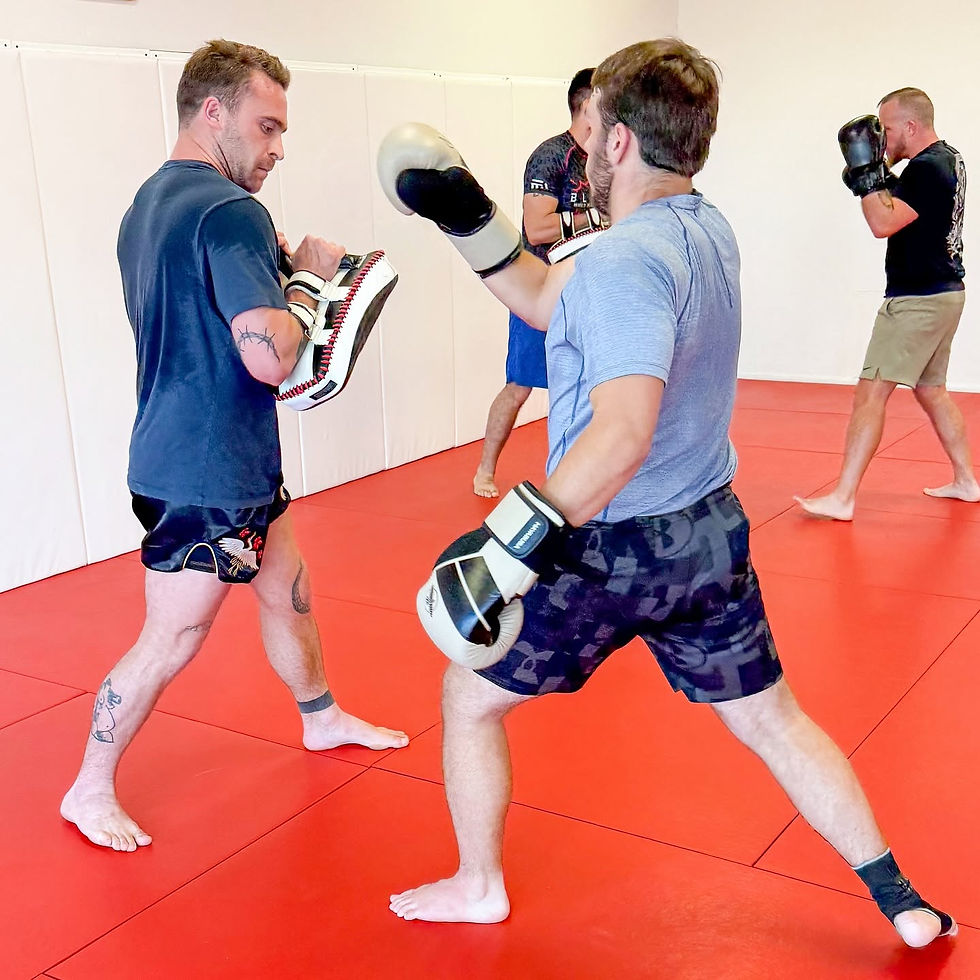
There is a funny way that partner drilling can go wrong. You can have two people standing across from each other and still not really be training reactions.
If the coach says, "You jab, I parry, you cross, I slip, you hook, I cover, then you kick," we technically have a partner drill. But the partner is really just a human heavy bag with better movement. There's nothing inherently wrong with that. There are times when you want predictable practice. When you're learning a new skill, predictability is useful.
The problem is when we never progress beyond it. At some point, the defender needs to have the freedom to give the attacker a different problem.
Maybe they retreat
Maybe they stay
Maybe they counter
Maybe they change levels
Now the attacker has to pay attention. That's when the drill starts becoming something different. The defender isn't helping the attacker finish the combination anymore. They're giving them a problem to solve.
This Doesn't Mean Everything Has to Be Random
I think there is another mistake that can happen when people hear "reaction-based training." They assume that the answer is to make everything completely random. I don't think that's particularly useful either. If I put a brand-new student into a completely open situation and tell them to figure out what to do, I've given them uncertainty without giving them enough knowledge to deal with it. That's not development.
There has to be progression.
First, the athlete needs to understand the technique
Then they need to understand the problem the technique solves
Then we can give them a predictable reaction
Then we can give them several possible reactions
Then we can make those reactions increasingly difficult to anticipate
Eventually, the athlete has to recognize the situation and make the decision without knowing the answer in advance. That's a much better way to develop decision making than simply making everything harder. The resistance should increase, but so should the uncertainty.
This Is Where MMA Becomes Different
This gets particularly interesting in MMA because the problem can change completely in the middle of an exchange.
Ex. You throw a punch and the opponent shoots. You sprawl and you find a front headlock. They escape and you end up in a clinch. You have them against the fence and they begin to pummel for an underhook.
That reaction might make a takedown available
It might make a different takedown available
It might create a striking opportunity
Or it might mean that the best decision is to stop forcing the attack and start over
This is one of the things that makes MMA such an interesting sport to teach. The skills are connected. A striking technique can create a wrestling problem. A wrestling attack can create a grappling problem. A grappling exchange can create a striking opportunity. You can't always know in advance which skill you are going to need next. That's why I think the ability to recognize transitions and reactions is just as important as knowing the individual techniques.
Eventually You Want the Athlete to Stop Waiting for the Coach
This is probably the biggest thing I'm looking for as an athlete develops. When someone is new, they constantly look to the coach for the answer. "What do I do here?" That's normal. But eventually I want them looking at their opponent instead. I want them thinking, "What is he giving me?" That's an important change.
The coach can't be there during the fight to say, "He's backing up, now throw the kick!" The athlete has to see it. The coach's job during training is to create enough opportunities for the athlete to learn how to see it. That's why I don't want reaction-based training to replace technical instruction. It should build on it.
We teach the athlete the tools first
Then we give them problems where those tools might be useful
Then we make the problems less predictable
Eventually, the athlete has to make the decision
Sparring Is Where It All Gets Tested
Eventually this has to show up in sparring. But I don't think the answer is to simply tell someone to spar more and hope the decision-making develops. Sparring is incredibly valuable, but it is also a very "noisy" learning environment. There are too many things happening at once to always know exactly what you're learning. That's why I like using constrained partner drills before and alongside sparring.
If I'm trying to improve someone's ability to recognize a takedown opportunity created by a striking reaction, I can create that specific problem and give them enough repetitions to actually learn it.
Then I can make it harder
Then I can put it into a more open situation
Then I can see whether it survives sparring
That's much more deliberate than simply hoping the athlete figures it out during rounds. Sparring is where we find out whether the skill works. It doesn't have to be the only place we develop it.
Your Heavy Bag Still Has a Job
None of this is an argument against heavy bags or pad work. I still use them. I still think they're extremely useful. There are times when I want an athlete to be able to throw 100 technically correct jabs without worrying about a partner. There are times when I want to work power, conditioning, footwork, combinations or mechanics. There are times when pad work is exactly what the athlete needs.
The point is simply that the bag, the pads, the partner and sparring all have a specific job. They don't all develop exactly the same things.
A heavy bag can help you develop the weapon.
Pad work can help you organize and sharpen the weapon.
Technical drilling can teach you how to use the weapon.
Reaction-based partner work can teach you when to use it.
Sparring can test whether you can use it when someone is actively trying to stop you.
I don't want to replace one with another. I want to use each one for what it is good at.
The Progression I Care About
When I look at an athlete's development, I want to see a progression from knowing techniques, to combining techniques, to understanding the problems those techniques solve, and eventually to being able to recognize and solve those problems in real time. That's a very different thing from simply accumulating combinations.
The beginner asks, "What am I supposed to do?"
The developing athlete starts asking, "What is my opponent doing?"
The experienced fighter is already answering that question while the exchange is happening.
That's the skill we're ultimately trying to build. Because a fight isn't a demonstration. Your opponent isn't standing there waiting for you to finish your combination. They're reacting to you. And you're reacting to them. The better you become at recognizing those reactions, the more options you have. Not because you've memorized more combinations, but because you understand what is actually happening.
That's why I like reaction-based training. We're not trying to make fighting more complicated. We're trying to make training a little more honest.
Your heavy bag can't fight back. Your training partner can. At some point, you need to learn from the person who's trying to stop you.


Comments